The phone case customization market continues to expand as consumers demand personalized accessories. When launching a phone case business, entrepreneurs face a critical decision: invest in a phone case vending machine that operates automatically, or staff a traditional kiosk with employees. This choice fundamentally affects profitability, scalability, and operational complexity. Understanding the financial implications of each model helps you allocate capital wisely and build a sustainable revenue stream in this competitive market segment.
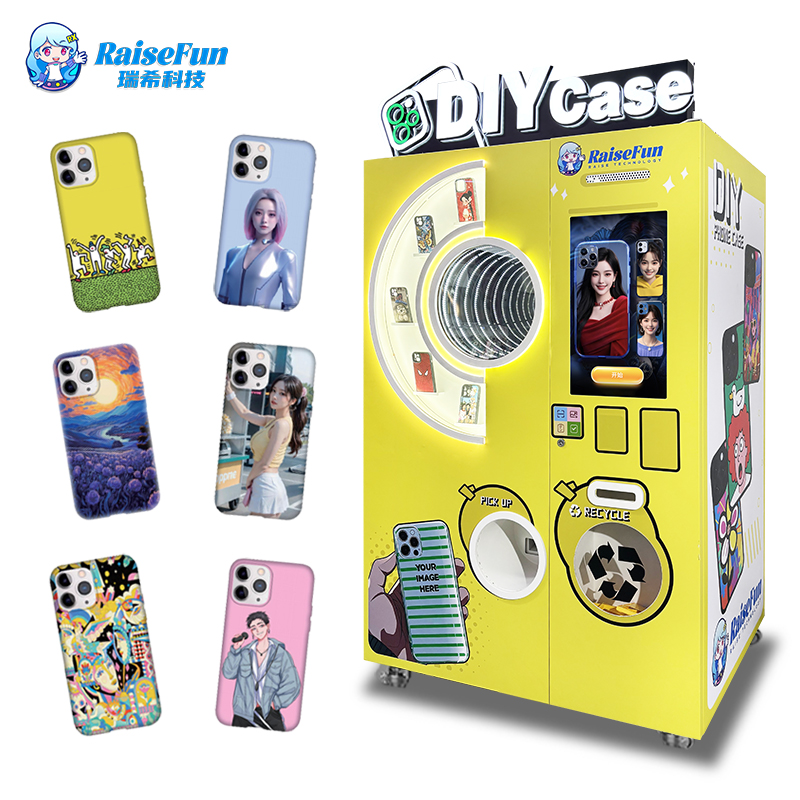
Both business models serve the same market demand but operate under entirely different cost structures. The phone case vending machine approach eliminates payroll burden and offers location flexibility, while staffed kiosks provide personalized service and higher transaction volumes in high-traffic areas. Analyzing initial investment, recurring expenses, labor costs, and profit margins reveals which model delivers superior financial returns for your specific market conditions and growth objectives.
A phone case vending machine represents a substantial upfront capital commitment. Modern automated phone case vending machines typically range from $8,000 to $25,000 depending on features, production speed, and customization capabilities. This single-unit investment covers the machine hardware, integrated printing technology, case inventory management system, and initial stock of phone case blanks. Beyond the machine itself, establishing a phone case vending machine business requires location securing, electrical setup, and initial inventory including multiple case styles and colors.
Additional setup expenses for a phone case vending machine deployment include permits, signage, connectivity infrastructure, and business licensing. These ancillary costs typically add $2,000 to $5,000 per location. Unlike a traditional retail kiosk, a phone case vending machine occupies minimal floor space, reducing rent-related expenses. However, the quality and technology sophistication of your phone case vending machine directly impacts customer satisfaction and repeat business, making equipment selection crucial for long-term success.
Selecting optimal locations for a phone case vending machine differs significantly from kiosk placement strategy. A phone case vending machine performs best in high-traffic venues including shopping malls, airports, transit stations, entertainment venues, and university campuses. These locations typically charge monthly placement fees ranging from $500 to $3,000 depending on foot traffic volume and venue prestige. Because a phone case vending machine operates unattended 24/7, location visibility and accessibility matter more than staff presence.
Infrastructure needs for a phone case vending machine remain minimal compared to staffed operations. The machine requires standard electrical power, internet connectivity for payment processing, and basic environmental protection from extreme temperatures or moisture. Most phone case vending machine operators can service multiple units weekly, rotating inventory and collecting revenue without maintaining permanent staff at each location. This scalability advantage fundamentally changes the financial model compared to staffed kiosk operations.
Staffed kiosk operations generate substantially higher recurring labor costs compared to phone case vending machine models. A typical kiosk requires two to three employees per shift to handle customer service, sales transactions, and inventory management. At $15 to $18 hourly wages plus payroll taxes, benefits, and training, annual labor costs for a single kiosk reach $80,000 to $150,000 minimum. When comparing this to a phone case vending machine that requires zero direct labor, the financial advantage of automation becomes immediately apparent.
Beyond hourly wages, staffed kiosk operations necessitate management oversight, scheduling coordination, and employee supervision. Seasonal demand fluctuations require flexible staffing arrangements, complicating payroll administration. A phone case vending machine operates consistently regardless of demand cycles, eliminating workforce scaling challenges. This operational simplicity particularly benefits entrepreneurs managing multiple locations, as a phone case vending machine portfolio scales without proportional labor cost increases.
Staffed kiosks demand continuous inventory management to maintain stock variety and prevent sales-blocking shortages. Customer browsing behavior and personalized recommendations increase case variety requirements compared to phone case vending machine operations. Restocking staffed locations requires coordination with scheduling, physical transportation, and time-intensive verification processes. These administrative overhead costs rarely appear in simplified profit calculations but substantially impact operational efficiency.
Phone case vending machine inventory management follows more predictable patterns. Service technicians restock during scheduled weekly or bi-weekly maintenance visits, collecting payments, refilling cases, and performing routine diagnostics. This consolidated approach reduces administrative overhead compared to coordinating staff-supervised restocking at multiple kiosk locations. Inventory turnover rates typically exceed staffed kiosk performance because phone case vending machine customers experience faster transaction times and reduced friction in the purchase process.
Staffed kiosks typically generate higher transaction volumes in premium locations because staff engagement drives impulse purchases and upselling. Average phone case vending machine transaction value ranges from $15 to $35, with staffed kiosks often achieving $20 to $45 through consultative selling and premium product recommendations. However, a phone case vending machine operates continuously without staffing constraints, capturing sales during night hours and low-traffic periods when kiosks remain unstaffed.
Daily revenue varies significantly based on location quality and customer demographics. A high-performing phone case vending machine in premium mall locations averages 15 to 25 transactions daily, generating $225 to $875 in daily revenue. Staffed kiosks in similar locations achieve higher per-transaction values but face capacity limitations during peak periods. Calculating annual phone case vending machine revenue requires realistic transaction volume estimates based on specific location foot traffic and target market spending patterns.
Phone case vending machine operations benefit from dramatically lower variable costs. Case material costs typically range from $3 to $8 per unit, printing materials add $1 to $3, and payment processing fees consume approximately 3 to 5% of transaction value. Net gross margin for a phone case vending machine reaches 60 to 75% per transaction. After accounting for equipment depreciation, location fees, maintenance, and connectivity costs, annual profit per machine ranges from $15,000 to $45,000 depending on location quality and operational efficiency.
Staffed kiosk profitability suffers under labor burden despite higher transaction values. With labor costs consuming 30 to 50% of gross revenue, staffed kiosk net margins often fall to 15 to 30% annually. A phone case vending machine achieving $100,000 annual revenue with 70% gross margin generates significantly higher net profit than a staffed kiosk achieving $150,000 revenue but facing 45% labor costs. Scaling a phone case vending machine business preserves margin expansion as additional machines operate at equivalent efficiency, while staffed kiosk scaling requires proportional labor cost increases.
One critical advantage of phone case vending machine business models lies in predictable scaling economics. Each additional phone case vending machine requires the same equipment investment, location fee, and minimal maintenance overhead. An operator managing five machines maintains similar administrative complexity and service time as managing two machines. This unit economics consistency enables rapid portfolio growth without proportional cost increases, creating attractive margins as the business scales.
Scaling staffed kiosk operations requires exponential cost growth. Each additional kiosk necessitates hiring and training new staff, increasing management overhead, and expanding operational complexity. Staffing challenges compound as business grows, with scheduling, employee retention, and quality control becoming increasingly difficult. Successful phone case vending machine operators often achieve 10 to 20 unit portfolios generating $200,000 to $500,000 annual profit. Reaching equivalent profit through staffed kiosks requires significantly larger initial capital and ongoing management intensity.
Phone case vending machine operations distribute revenue across multiple locations, reducing exposure to individual venue performance variability. Underperforming locations can be relocated or replaced with minimal sunk cost compared to staffed kiosk operations. This portfolio approach enables risk experimentation, allowing entrepreneurs to test new locations and adjust strategy based on performance data. A phone case vending machine failure results in equipment relocation, not permanent labor obligations or severance responsibilities.
Staffed kiosk revenue concentrates in fewer locations with higher fixed commitments. Underperforming staff drain profitability while complicating exit or reallocation strategies. Employee turnover disrupts operations and increases training costs. A phone case vending machine model inherently protects entrepreneurs from labor-related disruptions and delivers more predictable financial outcomes, particularly beneficial for first-time business operators building experience in the customized phone case market segment.
A phone case vending machine typically achieves payback within 12 to 18 months in quality locations generating consistent customer traffic. With conservative estimates of 10 to 15 daily transactions at $20 average transaction value, monthly revenue reaches $6,000 to $9,000. After subtracting location fees, operational costs, and maintenance, net monthly profit averages $1,500 to $3,000. This trajectory recovers the initial $12,000 to $20,000 equipment investment relatively quickly compared to staffed kiosk models requiring simultaneous labor cost recovery and equipment depreciation.
Yes, experienced operators successfully manage 10 to 30 phone case vending machines as a one-person operation. Weekly service rounds covering routine maintenance, inventory replenishment, payment collection, and technical diagnostics require 20 to 40 hours. This time investment per machine decreases substantially as portfolio size grows through route optimization and efficiency improvements. A phone case vending machine portfolio approach enables individual entrepreneurs to generate six-figure annual income without employing staff or managing complex organizational structures.
Location quality directly determines phone case vending machine financial performance. Premium mall locations with 50,000 monthly visitors generate 3 to 5 times higher transaction volumes than secondary locations. A phone case vending machine in top-tier venues generates $2,000 to $4,000 monthly profit, while identical machines in average locations produce $500 to $1,000 monthly profit. Successful operators prioritize location selection and negotiation, understanding that monthly placement fees of $1,000 to $2,000 justify themselves only through substantial traffic volume ensuring sufficient phone case vending machine transactions to achieve profitability targets.
 Hot News
Be the first to get our latest styles and offers.
Copyright © Guangzhou Ruixi Technology Co., Ltd.now All rights reserved - Privacy Policy

 EN
EN